
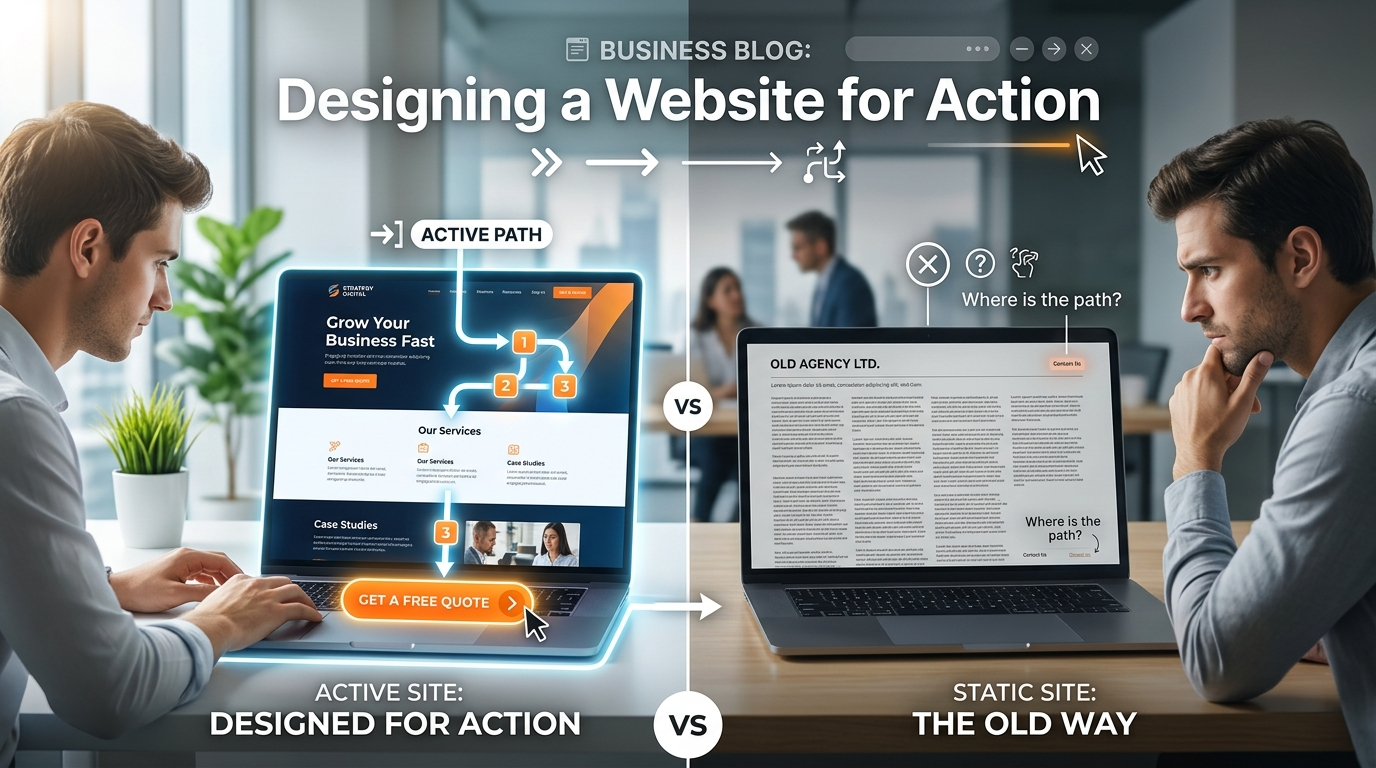
Many business websites read like a printed brochure that has been moved online. They describe the business beautifully, list the services, share the history, and then leave the visitor with nowhere obvious to go. They inform, but they do not guide. A website built that way might look professional, yet it quietly underperforms, because a website that grows a business is not a brochure. It is a tool designed for action.
This guide explains the difference between a brochure website and one designed for action, why it matters so much for your results, and how businesses can shift their site from passively describing the business to actively turning visitors into enquiries.
The brochure mindset versus the action mindset
A brochure exists to inform. It tells people about you and trusts them to do something with that information. That worked when a brochure was a leaflet someone picked up and took away with intent. Online, it falls short, because a visitor who finishes reading and finds no clear next step simply leaves, and the information was nice but nothing happened. A website designed for action starts from a different question. Not just what do we want to tell people, but what do we want them to do, and how do we guide them to do it? That shift, from informing to guiding, changes everything about how a site is built. The brochure describes and hopes. The action website leads the visitor, deliberately, toward becoming a customer.
Every page needs a purpose
On an action website, every page has a job beyond simply existing. Each page should guide the visitor toward a next step, whether that is to enquire, call, book or move to another page that leads there. A brochure website has pages that inform and then dead-end, leaving the visitor to decide what to do, which usually means doing nothing. An action website gives every page a clear purpose and a clear path onward. This does not mean being pushy, it means being helpful, always showing the visitor the natural next step rather than abandoning them at the bottom of the page. When every page moves the visitor closer to acting, the whole site works as a guide rather than a leaflet, and far more visitors reach the point of enquiring.
Make the next step obvious
The single clearest difference between a brochure and an action website is the presence of clear, obvious next steps. A brochure site buries or omits the call to action, so even an interested visitor is left with nowhere to go. An action site makes the desired next step obvious on every page, a prominent, clear call to action that tells the visitor exactly what to do and makes it easy. This is not decoration, it is the mechanism by which interest becomes an enquiry. A visitor who is convinced but not shown a next step will leave, taking their interest with them. Making the next step unmistakable, and easy to take, is what captures that interest before it evaporates. It is often the highest-impact change a brochure site can make.
Guide, do not just describe
An action website guides the visitor through a journey rather than presenting a static description and stopping. It anticipates the visitor’s questions and answers them in an order that builds toward acting. It addresses hesitations, provides reassurance, and leads the visitor step by step from arriving to enquiring. A brochure describes the business and leaves the visitor to navigate alone. An action site takes the visitor by the hand, understanding what they need to know and in what order, and guiding them toward the decision. This is a more thoughtful way to build a website, rooted in the visitor’s journey rather than the business’s desire to talk about itself, and it is what turns a passive reader into an active enquirer. The site works with the visitor, not just at them.
Build trust so action feels safe
Guiding a visitor toward action only works if they feel safe taking it. A visitor who is guided to a next step but given no reason to trust the business will still hesitate. So an action website weaves in the trust that makes acting feel comfortable, genuine reviews, real examples of work, clear information about who you are, and professional presentation. These reassure the visitor that the business is credible and that acting is a good idea. Trust and action work together, the guidance shows the way, and the trust makes the visitor willing to follow it. A site that guides without building trust pushes visitors toward a step they are afraid to take, while one that does both leads them confidently to an enquiry. Pairing this with strong SEO brings more of the right visitors to a site that then converts them.
A practical example
Consider a business with a professional-looking website that produces disappointingly few enquiries. Looked at closely, it is a brochure online. It describes the business well, lists the services, and shares the history, but every page simply ends. There are no clear next steps, no guidance toward acting, and little to build trust. Visitors read, learn about the business, and then leave, because nothing invited or guided them to do anything else.
The business redesigns it for action. It gives every page a clear purpose and a path onward. It adds prominent, obvious calls to action so the next step is unmistakable on every page. It restructures the content to guide the visitor through their questions in an order that builds toward enquiring, rather than just describing the business. And it weaves in genuine reviews and real examples so acting feels safe. The site does not necessarily look dramatically different, but it works completely differently. The same visitors are now guided, reassured and invited to act, and far more of them do. The website has stopped being a brochure that informs and become a tool that grows the business, which is what a website is actually for.
How Webrr Digital can help
Webrr Digital helps businesses grow through practical digital systems that bring together websites, SEO, AI visibility, automation and advertising. We design websites for action, giving every page a purpose, making the next step obvious, guiding visitors through their journey, and building the trust that makes acting feel safe, so your site turns visitors into enquiries rather than just informing them. If your website reads like a brochure, our website design service is built to make it work.
Frequently asked questions
What is the difference between a brochure website and an action website?
Why do brochure websites underperform?
What is the highest-impact change to make?
Does designing for action mean being pushy?
Do I need a full redesign to make my site action-focused?
Want a website that grows your business?
An action website guides visitors to enquire rather than just informing them. If you want help shifting yours from brochure to tool, the Webrr Digital team can redesign it for results.