



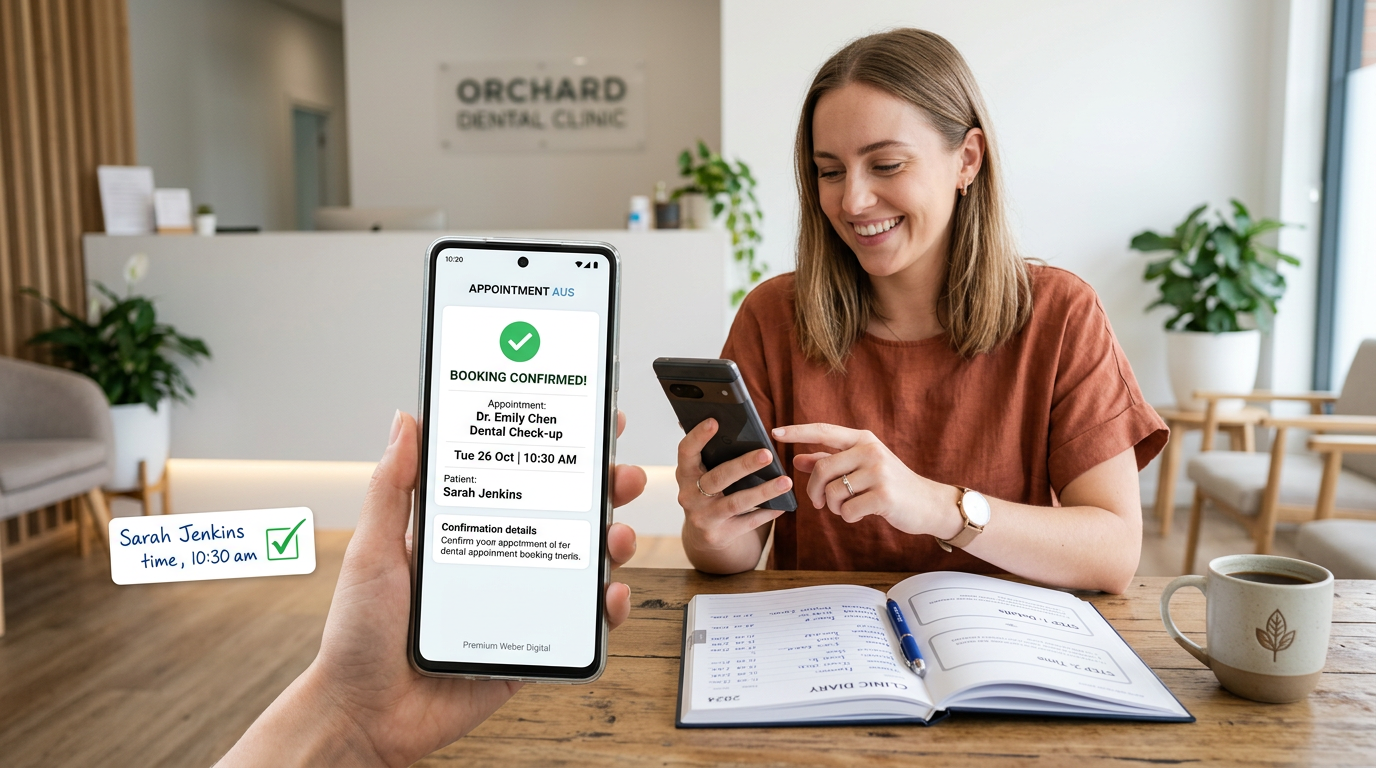
For any business that runs on appointments, from allied health clinics to dental practices, salons and beyond, the booking flow is one of the most important and most overlooked parts of the customer experience. A smooth booking flow quietly fills the diary, while a frustrating one quietly empties it, as patients abandon the process over small irritations they will never tell you about. The difference between the two is rarely dramatic. It is not usually one big failure but a series of small frictions that either ease patients through or push them away. Get them right and bookings flow. Get them wrong and you lose appointments you never knew you had a chance at.
This guide explains why booking flows matter so much, the small frictions that cost you appointments, and how to design a booking flow that fills the diary rather than frustrating the people trying to use it.
Why the booking flow matters so much
A patient who wants to book has already done the hard part. They have recognised they need your service and chosen to come to you. The booking flow is simply the path from that decision to a confirmed appointment, and it should be the easiest part of the whole journey. Yet it is frequently where businesses lose people, because a clumsy flow turns a ready, willing patient into a frustrated one who gives up. Every patient lost at this stage is the most expensive kind of loss, because they were already convinced. They were not a maybe, they were a yes, and a poor booking flow turned that yes into nothing. This is why the booking flow deserves far more attention than it usually gets.
The small frictions that cost appointments
Booking flows rarely fail because of one big problem. They fail through an accumulation of small frictions, each of which sheds a few more people.
- A process with too many steps, asking for more than is needed before the booking is made.
- Forms that demand excessive information up front, when much of it could come later.
- Confusing or unclear options that leave the patient unsure what to choose.
- A flow that does not work well on a phone, where many patients are trying to book.
- Slow loading or a clunky interface that tests the patient’s patience.
- No clear confirmation, leaving the patient unsure whether the booking actually worked.
Each of these seems minor, but each one sheds a few more patients, and together they can turn away a large share of the people who set out to book. The frustrating part is that none of them are hard to fix once you know to look for them.
Make it effortless
The guiding principle for a booking flow is to make it effortless. Every step, every field and every decision you ask of the patient is a small barrier, and each barrier loses a few more people. The fewer steps, the less information demanded up front, and the clearer the choices, the more patients complete the booking. This means stripping the flow back to what is genuinely necessary to secure the appointment, and gathering anything else later. A patient should be able to move from deciding to book to a confirmed appointment quickly and without friction. The easier you make it, the fuller your diary, because you stop losing the patients who were willing but not willing to fight through a difficult process.
Design for the phone first
A large and growing share of bookings happen on a phone, often the moment the patient decides they need an appointment. A booking flow that works beautifully on a desktop but is awkward on a phone is failing most of the people trying to use it. Designing for the phone first, with large tap targets, minimal typing, and a layout that works on a small screen, is essential, not optional. The patient on their phone is often the most ready to book, deciding in the moment, and a mobile-friendly flow captures that readiness while a clumsy one squanders it. If you only get one thing right about your booking flow, make it work effortlessly on a phone, and a fast, well-built website underpins that.
Confirm clearly and reassure
The booking is not truly complete until the patient knows it worked. A flow that ends ambiguously, with no clear confirmation, leaves the patient uncertain and anxious, wondering whether they actually have an appointment. That uncertainty undermines the whole experience and can prompt a confused phone call or a no-show. A clear, immediate confirmation, ideally reinforced by a follow-up, reassures the patient that everything is sorted and they can relax. This final reassurance matters more than businesses realise, because it is the difference between a patient who feels confidently booked and one who feels unsure. A connected confirmation and reminder system closes the loop and quietly reduces no-shows at the same time.
A practical example
Consider an allied health clinic that is busy but feels its online bookings underdeliver. Looking at the flow as a patient would reveals the problem. The process runs to many steps. It asks for a long list of personal and health details before the appointment is even secured. The options are confusing, the interface is awkward on a phone, and at the end there is no clear confirmation. Plenty of patients start, but a frustrating number give up partway, and the clinic never knows how many appointments it quietly lost.
The clinic redesigns the flow around effortlessness. It cuts the steps to the essentials, asking only for what is needed to book and gathering the rest later. It clarifies the options so patients always know what to choose. It rebuilds the flow to work smoothly on a phone, where most patients are. And it ends with a clear, immediate confirmation, reinforced by a reminder. The change is striking. Far more of the patients who start now finish, the diary fills more reliably, no-shows fall thanks to clear confirmations and reminders, and patients describe booking as easy rather than annoying. The clinic did not find more patients. It simply stopped losing the ones it already had to a flow that frustrated them.
How Webrr Digital can help
Webrr Digital helps businesses grow through practical digital systems that bring together websites, SEO, AI visibility, automation and advertising. For appointment businesses, we design booking flows that are effortless, phone-first and clearly confirmed, connected to reminders that reduce no-shows, so the diary fills instead of leaking. If your booking flow is costing you appointments, our website and booking work is built to fix it.
Frequently asked questions
Why do patients abandon online bookings?
What is the single most important thing to get right?
How much information should I ask for up front?
Does the confirmation really matter?
Will fixing the flow really fill the diary?
Want a booking flow that fills the diary?
A smooth, phone-first booking flow recovers appointments friction was quietly costing you. If you want help designing one, the Webrr Digital team can show you how.