



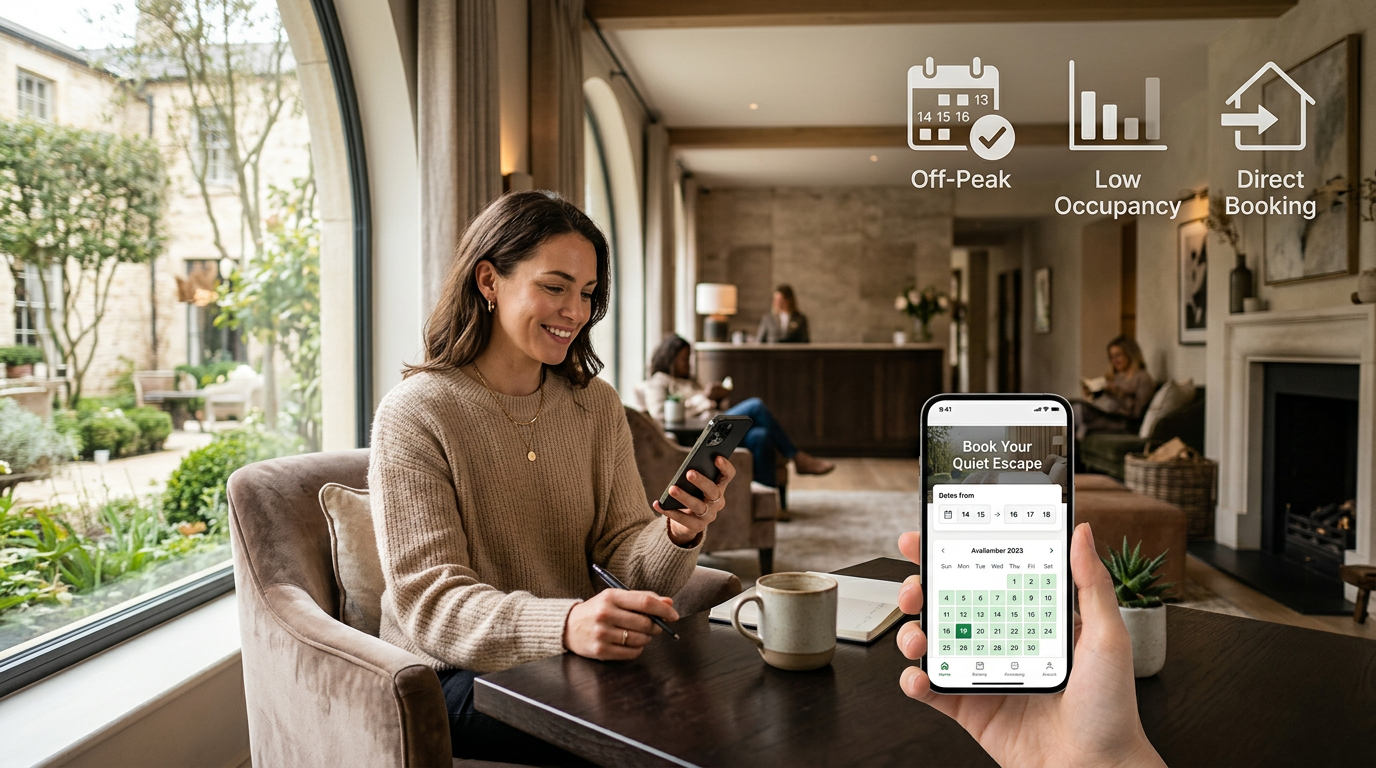
Peak season sells itself. Rooms fill, rates hold, and marketing feels almost optional. The shoulder season is where marketing actually earns its keep, because demand no longer arrives on its own and every occupied room is one you had to go and win. For most hotels and accommodation providers, the difference between a good year and an average one is not what happens in the busy weeks, it is how well they fill the quieter ones.
This guide is a practical playbook for filling rooms in the shoulder and off-peak seasons, covering who to target, what to offer, and how to build the demand that does not simply turn up by itself.
Why the shoulder season is won or lost on marketing
In peak season, demand exceeds supply, so the job is mostly managing rates and availability. In the shoulder season, supply exceeds demand, and the hotel that markets best takes more than its fair share of a smaller pool of travellers. This is precisely why the quieter months reward marketing so heavily, because occupancy is no longer given, it is competed for. A property that treats the off-peak weeks passively, waiting for bookings that used to arrive on their own, watches its occupancy sag. A property that treats them as a marketing challenge, actively creating reasons to visit and reaching the right travellers, fills rooms its competitors leave empty. The shoulder season is not a problem to endure, it is an opportunity to out-market the properties around you, and the margin uplift from a fuller off-peak calendar flows straight to the bottom line.
Know who actually travels off-peak
Filling shoulder-season rooms starts with understanding who is willing to travel when the crowds have gone, because it is rarely the same audience as your peak guest. Off-peak travellers often include people with flexible schedules, those chasing value and quieter experiences, people travelling for a specific reason rather than the season, and guests within easy reach who can be tempted by a short break. Each of these audiences responds to different messages, and lumping them together produces bland marketing that moves no one. A property that identifies the specific off-peak audiences it can realistically win, and speaks to what each of them actually wants, markets far more effectively than one broadcasting a generic discount to everyone. Knowing who travels in the quiet months, and why, is the foundation the rest of the playbook is built on.
Give people a genuine reason to come now
A quiet season is quiet because the usual reasons to visit have faded, so the job of marketing is to supply new ones. That means creating and promoting genuine reasons to come now rather than wait, whether that is value, a distinct experience the season itself makes possible, an event or package, or simply the appeal of a calmer, less crowded stay. A discount alone is a weak reason, easily matched and quick to erode your rate, whereas a real reason to visit, a reason that is specific and appealing, pulls bookings without gutting your margin. The properties that fill off-peak rooms well are the ones that manufacture demand deliberately, giving travellers a compelling answer to the question of why here, why now. Give people a reason worth acting on, promote it clearly, and the shoulder season stops being something that happens to you and becomes something you shape.
Lead with direct, and make booking effortless
Every off-peak room you fill is worth more when the guest books directly, because you keep the margin and own the relationship rather than handing both to an intermediary. That makes the shoulder season the ideal time to lean into direct bookings, offering your best reasons to visit on your own channels first, funded partly by the commission you save. None of it works, though, if booking directly is awkward, so a fast, clear, mobile-friendly booking experience on your own website is essential. If your direct booking process is slower or more confusing than the alternatives, ready guests will drift away and book elsewhere, and your off-peak marketing will quietly subsidise someone else. Combine a compelling reason to visit with an effortless way to book it directly, and you fill rooms at a better margin while building a guest base you actually own, which is exactly what the quiet months should be used for.
Reach the right travellers before they decide
A great off-peak offer only works if the right travellers actually see it, which is where reaching people deliberately, rather than hoping they stumble across you, becomes essential. That means being visible where potential guests research and compare, staying in front of past guests and enquirers who already know you, and using targeted advertising to put your reason-to-visit in front of the specific audiences most likely to act. Past guests are especially valuable in the quiet season, because they already trust you and cost far less to reach than strangers, so a simple system for keeping in touch and inviting them back pays for itself. The properties that fill shoulder-season rooms are not the ones with the best offer sitting unseen, they are the ones whose good offer reaches the right travellers at the moment they are open to a trip, and a little automation makes that outreach reliable rather than occasional.
A practical example
Consider an accommodation provider whose peak weeks are busy and profitable, but whose shoulder season sags year after year. It has treated the quiet months passively, trimming rates and hoping for bookings that no longer arrive on their own, and it watches nearby properties seem to cope better. Its off-peak occupancy drifts lower, its margin with it, and the quiet season feels like something simply to be endured.
It decides to treat the shoulder season as a marketing challenge instead. It identifies the specific off-peak audiences it can realistically win, flexible and value-minded travellers, and people close enough for a short break. It creates a genuine, specific reason to visit now, a distinctive off-peak experience rather than a bare discount, and promotes it clearly on its own channels first to protect margin. It rebuilds its direct booking process to be fast and effortless on a phone, and it reaches out to past guests and enquirers who already trust it, inviting them back. The change is meaningful. Off-peak occupancy lifts as rooms that used to sit empty are filled, and because more of those bookings are direct, the margin on them is stronger. The quiet season stops being a drag on the year and becomes a period the property actively wins, which is exactly what a shoulder-season playbook is for.
How Webrr Digital can help
Webrr Digital helps businesses grow through practical digital systems that bring together websites, SEO, AI visibility, automation and advertising. For hotels and accommodation, we help you identify the off-peak audiences you can win, build genuine reasons to visit, make direct booking effortless, and reach the right travellers before they decide, so your shoulder season fills at a healthier margin. If the quiet months are costing you occupancy, our website, booking and campaign work is built to turn them around.
Frequently asked questions
Why does the shoulder season need so much more marketing than peak?
Is discounting the best way to fill off-peak rooms?
Who should hotels target in the quiet season?
Why focus on direct bookings in the shoulder season?
How do past guests help fill off-peak rooms?
Want a fuller off-peak calendar?
Filling shoulder-season rooms is a marketing job, and it is very winnable with the right plan. If you want help turning your quiet months around, the Webrr Digital team can show you how.