



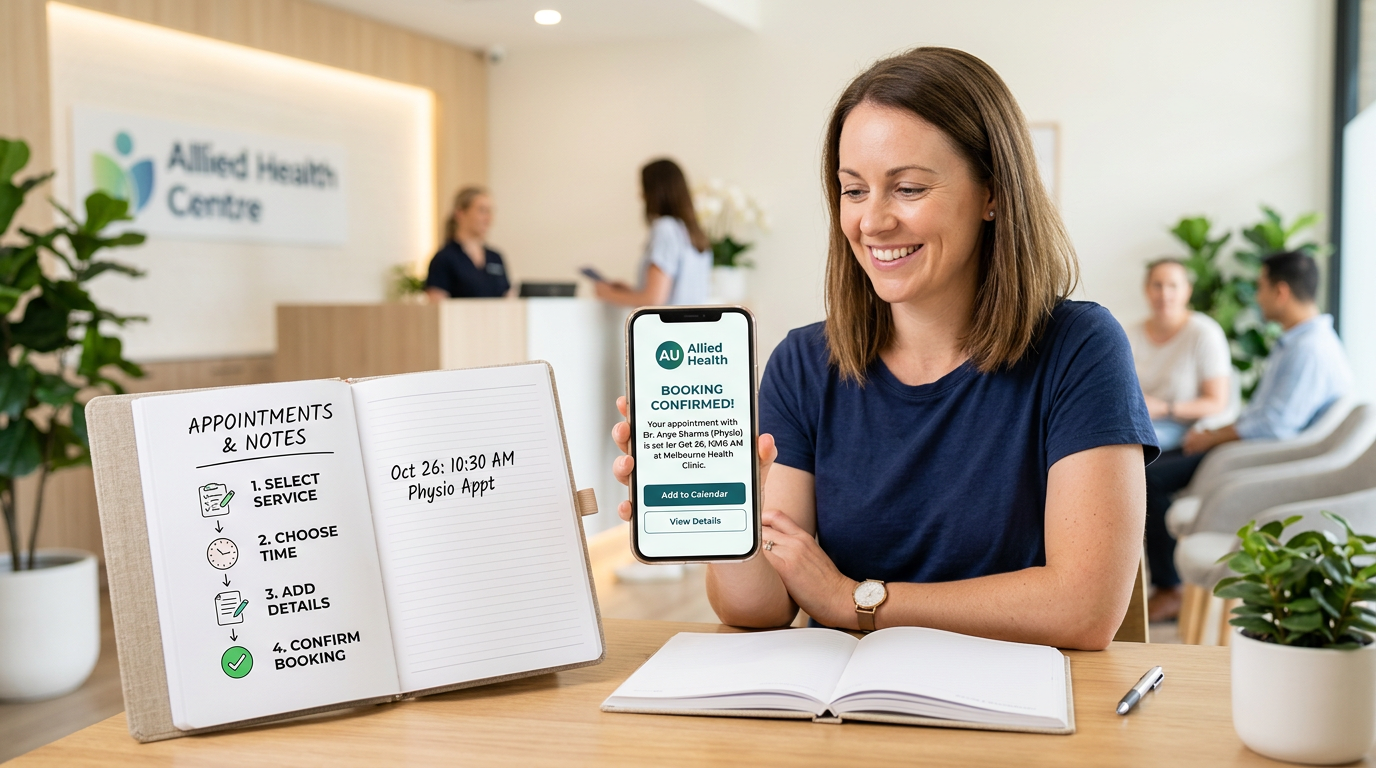
Patients increasingly want to book healthcare the way they book everything else, online, on their own time, without having to phone during business hours. For allied health clinics, from physiotherapy and podiatry to psychology and dietetics, this shift is an opportunity. Yet many clinics still make online booking harder than it needs to be, and they quietly lose appointments because of it. The demand is there. The friction is what holds clinics back.
This guide looks at why allied health clinics so often struggle with online bookings, what the common friction points are, and how Australian clinics can create a booking experience that fills the diary and reduces no-shows.
Patients now expect to book online
Expectations have changed. A patient who can book a restaurant, a haircut and a flight online naturally expects to book their physio or psychologist the same way. When they cannot, or when the process is awkward, it creates a small but real barrier at exactly the moment they were ready to act. Some will phone instead, but others, especially those who find calling during business hours inconvenient or who simply prefer online, will hesitate, delay, or look elsewhere. Meeting the patient’s expectation to book online, easily, is no longer a nice extra, it is increasingly what patients assume a clinic will offer. Clinics that make online booking smooth capture demand that clinics relying on the phone quietly lose, because they force the patient to act in a way that no longer suits them.
Friction point: too complicated
A common struggle is a booking process that is simply too complicated. A patient wanting to book should be able to do so quickly and easily, but many clinic systems ask too much, present confusing options, or run to too many steps. Faced with a complicated process, patients abandon it, especially when they were only tentatively ready in the first place. The more steps, fields and decisions between the patient and a confirmed appointment, the more people drop off along the way. Allied health booking is often more complex than, say, booking a table, because of appointment types, practitioners and requirements, but that is exactly why the process must be designed carefully to stay simple. A complicated booking flow is one of the biggest reasons clinics lose the online appointments they could have had.
Friction point: not built for the phone
Many patients try to book on their mobile, often the moment they decide they need an appointment. A booking system that works on a desktop but is awkward on a phone fails a large share of the people trying to use it. Small text, hard-to-tap options and a layout that does not fit a small screen frustrate mobile patients into giving up. Given how many people do everything on their phones, a booking experience that is not genuinely mobile-friendly is losing appointments constantly. The patient on their phone is frequently the most ready to book, deciding in the moment, and a poor mobile experience squanders exactly that readiness. Making the booking process work beautifully on a phone is not optional for a clinic that wants to capture online bookings, it is essential.
Friction point: no confirmation or reminders
The booking process does not end when the patient submits, it ends when they feel confident the appointment is secured and are reminded so they attend. Clinics that provide no clear confirmation leave patients unsure whether they actually have an appointment, which undermines the experience and can prompt confused calls. And clinics that send no reminders suffer more no-shows, appointments the patient simply forgot. A clear confirmation immediately after booking, followed by a well-timed reminder, reassures the patient and protects the appointment. Missing these steps is a common and costly oversight, because it turns a booking into an uncertain, easily-forgotten event rather than a confident, kept appointment. A connected confirmation and reminder system closes this gap and reduces no-shows at the same time.
Design the booking experience around the patient
The thread running through every friction point is a failure to design the booking experience around the patient. Clinics often set up booking around their own internal systems and requirements, then wonder why patients struggle. The better approach is to design from the patient’s perspective, making it simple, fast, mobile-friendly, clearly confirmed and reliably reminded. When the booking experience is built around what makes it easy for the patient, more of them complete it, the diary fills, and no-shows fall. This does not require abandoning the clinic’s needs, it requires meeting them in a way that stays effortless for the patient. A booking experience designed around the patient, and supported by a clear website, turns online booking from a source of lost appointments into a reliable way to fill the diary.
A practical example
Consider an allied health clinic that is busy but frustrated that its online bookings underdeliver. Reviewed through a patient’s eyes, the problems are clear. The booking process is complicated, with many steps and confusing options. It is awkward on a phone, where many patients try to book. And it offers no clear confirmation and no reminders, leaving patients unsure and prone to forgetting. Plenty of patients start to book, but a frustrating number give up or fail to show, and the clinic never sees how many appointments it quietly lost.
The clinic redesigns the experience around the patient. It simplifies the process to the essential steps, with clear options. It rebuilds it to work smoothly on a phone. And it adds an immediate confirmation and a well-timed reminder. The effect is significant. Far more of the patients who start now complete their booking, the diary fills more reliably, and no-shows fall thanks to clear confirmations and reminders. The clinic did not find more patients, it simply stopped losing the ones it already had to a booking experience that made things hard. Meeting the patient’s expectation to book easily online, on their phone, with confidence, turned a source of lost appointments into a dependable way to fill the diary.
How Webrr Digital can help
Webrr Digital helps businesses grow through practical digital systems that bring together websites, SEO, AI visibility, automation and advertising. For allied health clinics, we design booking experiences around the patient, simple, fast, mobile-friendly, clearly confirmed and reliably reminded, so online booking fills the diary and reduces no-shows instead of quietly losing appointments. If your clinic’s online bookings underdeliver, our website and booking work is built to fix it.
Frequently asked questions
Why do allied health clinics lose online bookings?
Do patients really expect to book healthcare online?
Why does mobile matter so much for clinic bookings?
How do confirmations and reminders help?
How do I improve my clinic’s online bookings?
Want online bookings that fill the diary?
Designing the booking experience around the patient recovers appointments friction was costing you. If you want help fixing yours, the Webrr Digital team can show you how.