
Search ads catch people who are already looking for what you do. Meta advertising, across Facebook and Instagram, works differently. It puts your offer in front of the right people before they start searching, interrupting the scroll with something worth stopping for. Done well, it can be a genuine source of quality leads for service businesses. Done carelessly, it becomes a steady drain that produces likes but no work. The difference, as with most advertising, comes down to structure, offer and measurement.
This guide lays out a campaign structure that works for Australian service businesses, and the thinking behind it, so your Meta advertising generates real enquiries rather than vanity metrics.
Why Meta ads need a different approach
On search, the person has already decided they want a plumber or a physio, and is choosing who to call. On Meta, they are scrolling through photos and updates, not looking for you at all. That single difference changes everything. Your ad has to earn attention, not just capture existing demand. The message has to be worth stopping for, and the offer has to give a reason to act now rather than scroll on. Treating Meta like search, with a dry list of services, is why so many campaigns quietly fail. Understanding that you are interrupting, not intercepting, is the foundation of every other decision, and it is the piece most struggling campaigns get wrong from the start.
Lead with a compelling offer
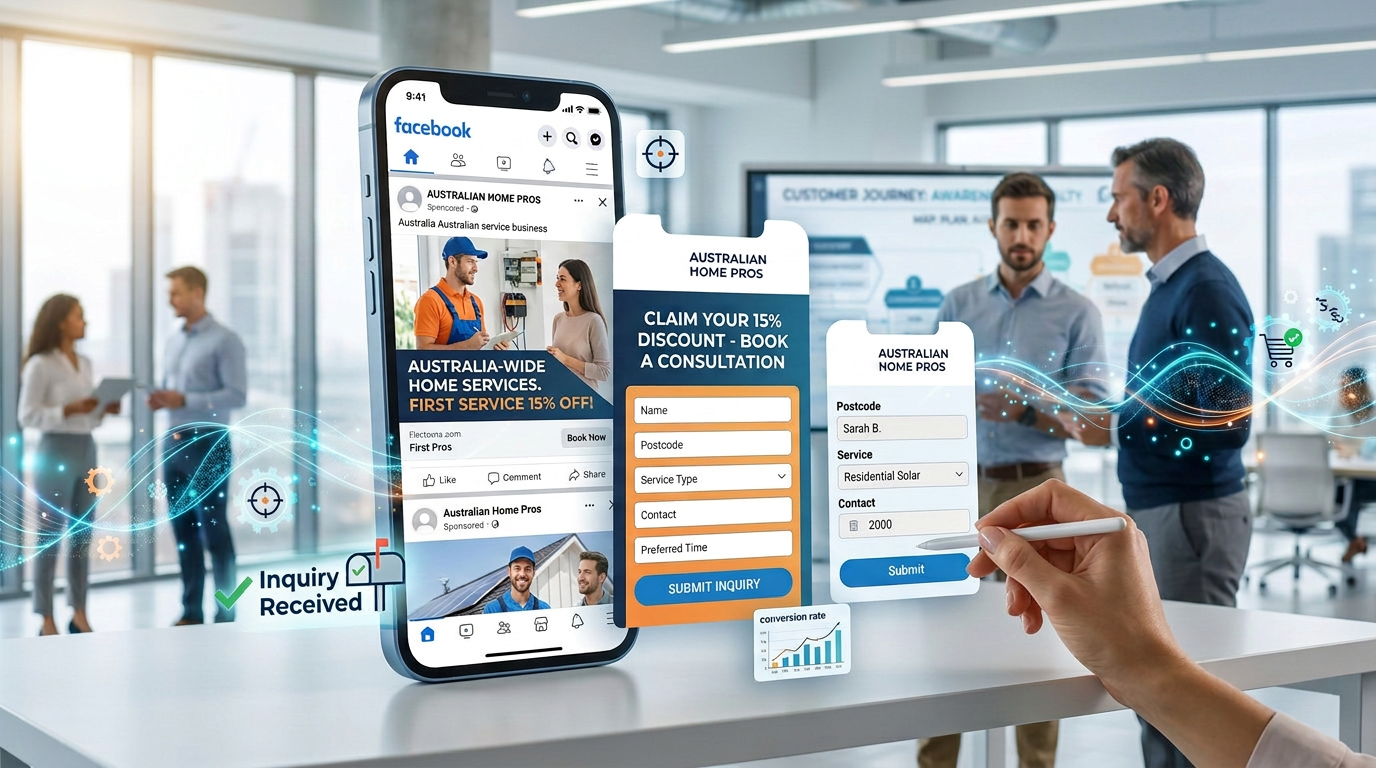
Because you are interrupting the scroll, the offer has to do the heavy lifting. A specific result, a clear benefit, or a genuine incentive works far better than a general brand message. People respond to something concrete and relevant, a reason to stop and act now, not a vague invitation to remember you exist. The offer does not have to be a discount. It can be a useful resource, a free assessment, a clear and appealing outcome, or a limited opportunity. What matters is that it is specific, valuable to the right people, and gives a reason to respond immediately. A strong offer can carry an average campaign, while a weak offer sinks even a beautifully made one. Get the offer right before worrying about anything else.
Target the right people
Meta’s value is in reaching the right people before they search, so who you target matters enormously. Showing your offer to a broad, poorly chosen audience wastes budget on people who will never want your service. Defining your ideal customer, by location, interests, behaviours or by building audiences from people who already resemble your customers, focuses your spend on those most likely to respond. For a local service business, getting the location and audience right is especially important, since there is no point advertising to people outside your service area. Good targeting is what turns Meta from a scattergun into a precise tool. The better you define who should see your offer, the less budget you waste and the more genuine leads you generate.
Structure the campaign clearly
A clear structure lets you control and improve your advertising rather than guessing. Organising your campaign sensibly, separating different offers, audiences or objectives so you can see what each is doing, gives you the visibility to learn and optimise. A jumbled campaign, with everything mixed together, makes it impossible to tell what is working and what is wasting money. A clear structure lets you see which offers and audiences perform, direct budget toward them, and cut what does not work. This does not need to be elaborate, just logical and clear enough that you can read the results and act on them. Structure is what makes a campaign improvable rather than a black box you simply feed money into and hope.
Send clicks somewhere built to convert
A Meta ad that earns the click is only half the job. Where that click lands determines whether interest becomes an enquiry. Sending people to a generic homepage or a slow, unconvincing page wastes the attention you worked to capture. A focused landing page that matches the offer, loads fast, and makes taking the next step easy is what converts the click into a lead. The ad and the page after it are a single journey, and they must align. Many service-business Meta campaigns fail not because the ads are bad, but because the click lands somewhere that lets the interest evaporate. Getting the destination right protects everything you spent to earn the click, and is often the cheapest fix available.
Measure what actually matters
Meta makes it easy to be seduced by vanity metrics, likes, reach and engagement that look good but do not pay the bills. For a service business, the metric that matters is enquiries, real leads that can become customers. Setting up your campaign so you can see how many genuine enquiries it produces, and at what cost, keeps you focused on results rather than appearances. A campaign with modest likes but a steady flow of quality enquiries is succeeding, while one with lots of engagement but no leads is not, however impressive it looks. Measuring the right thing is what keeps Meta advertising honest and lets you judge, fairly, whether it is earning its place in your marketing.
A practical example
Consider a local service business trying Meta ads and feeling disappointed. Its ads list its services in a dry, brochure-like way, show to a broad audience well beyond its service area, all sit in one jumbled campaign, send clicks to a slow generic homepage, and are judged by likes. The result is plenty of engagement and almost no work, so the business concludes Meta does not work for it.
It rebuilds with the right structure instead. It leads with a specific, compelling offer that gives people a reason to act now. It tightens targeting to its ideal customers within its actual service area. It organises the campaign clearly so it can see what performs. It sends clicks to a focused, fast landing page built to convert and matched to the offer. And it measures genuine enquiries and their cost rather than likes. The transformation is striking. The same channel that produced only vanity metrics now generates a steady flow of real, quality enquiries at a sensible cost. Meta did not change. The structure, offer, targeting, destination and measurement did, and that is what turned a drain into a dependable source of leads.
How Webrr Digital can help
Webrr Digital helps businesses grow through practical digital systems that bring together websites, SEO, AI visibility, automation and advertising. For Meta advertising, we build campaigns around a compelling offer, precise targeting, clear structure, a converting landing page and proper measurement, so Facebook and Instagram generate real enquiries rather than vanity metrics. If your social advertising is producing likes but no work, our advertising team can rebuild it to perform.
Frequently asked questions
Why are Meta ads different from search ads?
What is the most important part of a Meta campaign?
How should I target Meta ads for a local service business?
Why is my Meta campaign getting likes but no enquiries?
What should I measure on Meta?
Want Meta ads that generate real enquiries?
The right structure turns Meta from a drain into a dependable source of leads. If you want help building it, the Webrr Digital team can set it up for you.